
Getting to the Start Line: The Race Before the Race

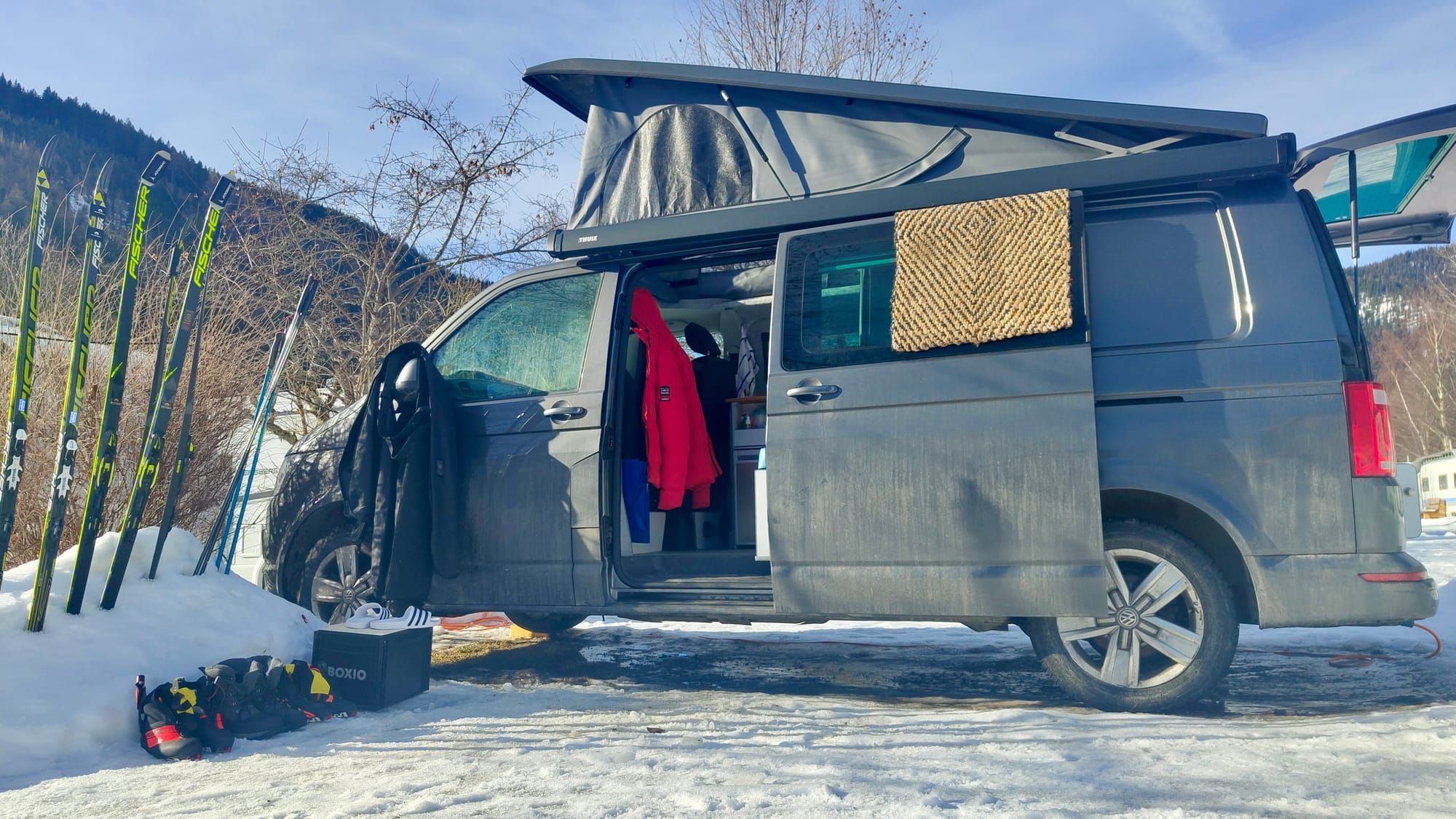
By the time I stood on the start line of the Marcialonga, I already felt like I’d ticked a massive box.
Not because I thought I was going to race well — I really didn’t — but because I’d actually made it there. This was my third attempt at getting myself onto that start line, and with that came a weird mix of excitement, pressure, and that slightly grim feeling in your stomach that says, this has to be the one. I felt properly sick beforehand. Not just cold sick. Proper nerves sick.
This time it was just me and the van. No support crew. No clever logistics. No safety net. If it went wrong, it was on me to fix it. That’s quite a sobering way to start a race week, but also strangely freeing. There’s something about knowing there’s no backup plan that sharpens the mind.
What people mostly see is race day. The bib. The snowy photos. The finish line. What they don’t see is the months of faffing about beforehand — the driving, the planning, the cancelled races, the “is this even worth it?” conversations you have with yourself at stupid o’clock in the morning.
For me, the real race started long before anyone fired a starter’s pistol.
December: Chasing Winter
The whole thing kicked off in early December when I drove the van out and started whatever on-snow training I could find. That’s the key word: find. Snow wasn’t exactly plentiful, so it felt less like a winter training block and more like a scavenger hunt.
I went home for Christmas to grab some work shifts and pretend I was having a normal festive period, then headed straight back out just after Christmas and drove back to Ramsau. Up until then, most of my skiing had been what I’d call “voyages of discovery” — going out, exploring tracks, getting time on skis, but not really following anything that looked like a proper plan.
Ramsau was where that had to change. Less mucking about. More turning up and doing the session whether I fancied it or not. It’s amazing how quickly skiing stops being romantic once it’s written down on a bit of paper as “180 minutes Z2, again.”
Summer Reality Check
If I’m honest, the summer training never really settled into a proper groove. A new job, a run of niggles, and a general lack of life structure meant consistency was hit and miss. Instead of building nicely, it often felt like I was just trying to stop things unraveling.
At some point, the goal shifted. It stopped being about being “race fit” and became about something much simpler:
Just get to the start line.
Not peak condition. Not hero workouts. Just healthy, not injured, not ill, and with a van that hadn’t decided to have a personality crisis in a lay-by somewhere in Bavaria.
That meant being conservative. Probably more conservative than my ego would have liked. But I’ve done enough endurance stuff over the years to know that turning up broken is a great way to guarantee a miserable experience.
The Races That Never Happened
Bad Gastein was meant to be my early-season yardstick. A short race. Nothing too serious. Just a way of seeing where I was at.
The day before, I felt awful. Not the usual “altitude hangover” feeling. Proper dizzy. Hot. Just not right. I remember standing there thinking, this is not how this is supposed to feel.
So that was that. No start line.
Next up was Ramsau. Cancelled. Not enough snow.
At that point, I was staring down the barrel of Marcialonga with no real race miles and two years without proper race experience. Physically, I could train. Mentally, it felt like stepping into something untested. Again.
Winter Vanlife: The Bit No One Puts on Instagram
Living in a van in winter — especially a small pop-top VW — is where the romantic vanlife narrative dies a quick death.
Things get real small, real quick.
When it’s minus 15 or minus 20 outside, the whole game becomes: keep the cold out and the heat in. The diesel heater becomes the single most important thing in your life. If it throws an error code at 3am, you’re instantly very awake and very motivated to fix it.
Cold has a way of cutting through any motivational nonsense you might have.
Everything takes longer too. There’s no multitasking. You can’t put the kettle on while putting the bed away without risking setting fire to your bedding. Every job has an order. Miss the order, and you’re swearing at yourself in a space the size of a phone box.
It’s also very easy to kid yourself that you’re on some kind of extended holiday. Eat out. Treat yourself. Except doing that for weeks on end is a great way to rinse your bank account and slowly expand your waistline at the same time.
So you end up learning how to cook properly on two small hobs with about three pans and not much worktop. Not glamorous, but it works.
Campsites, Batteries, and Mental Load
There’s a big myth in vanlife that once you’ve got a van, travel is basically free. In summer, maybe. In winter, in Europe, not so much.
Park-ups can work, but they come with hassle: being moved on, the odd knock on the door, and the constant low-level worry about power. The diesel heater still needs electricity, and once you start watching battery percentages in sub-zero temperatures, it becomes another thing taking up headspace.
I had an electric hook-up fitted to the van this year, and honestly, it’s been one of the best upgrades I’ve made. Being able to plug in and not lie there wondering if the battery will make it through the night is a massive mental relief.
Winter campsites also come with some serious bonuses: hot showers, drying rooms, ski wax rooms, WiFi — and, in Austria and Germany, saunas. The first time you wander into a sauna in a freezing campsite you feel slightly ridiculous. A week later, you’re planning your training around it.
For a lot of my longer days, the sauna became the carrot. Get the session done, get warm, sit there sweating, and pretend that this is all part of some master plan.
Training Plans, AI, and Letting Go of Perfection
Coming from a long-course triathlon background, I’m no stranger to training plans. What I do struggle with is turning a strategic, high-level view into a granular, session-by-session plan that actually gets executed week in, week out.
It’s not that I can’t do it. It’s more that I often don’t sit down and build it properly.
This winter, I used ChatGPT as a tool to help generate a rough day-by-day structure. That’s not something I’d recommend blindly. Like anything with AI, it needs to be sanity-checked. If you don’t know what red flags to look for, you can get yourself into trouble quickly.
Used properly though, it helped me get out of my own way and actually follow something resembling a plan.
Ramsau: Learning to Be Bored
When I arrived in Ramsau, I only had about 5km of track to play with. That makes training very boring, very quickly.
“Ski boring” is a phrase often used to ground high-octane speed merchants — people who always want to go hard, go fast, chase intensity. It became a useful reminder for me. Base work is not glamorous. It’s repetitive. It doesn’t make for exciting Strava titles. But it’s the foundation.
In that sense, Ramsau became as much a mental training block as a physical one: learning to accept monotony, to trust the process, and to leave the ego at the door.
Italy: The Ribbon of Snow
After the main bulk of training in Ramsau — and a few half-hearted attempts at vlogging and social media — it was off to Italy for taper week and course familiarisation.
I arrived to brown meadows and no natural snow. Even the Olympic ski jump just down the road, with all the resources being pumped into it, was looking somewhat lost and forlorn.
The course itself, at that point, consisted of a thin, three-metre-wide strip of artificial snow stretching for 70km through the valley, offset by frozen brown meadows and pine trees. It was a surreal sight: winter reduced to a ribbon.
The new campsite had all the usual offerings, just a bit noisier — this is Italy, after all.
After everything it had taken just to get here, the course felt like a warning shot.
Tomorrow wouldn’t be about racing.
It would be about surviving whatever the valley decided to throw at us.